How To Use “Students’ And Student’s” In A Sentence
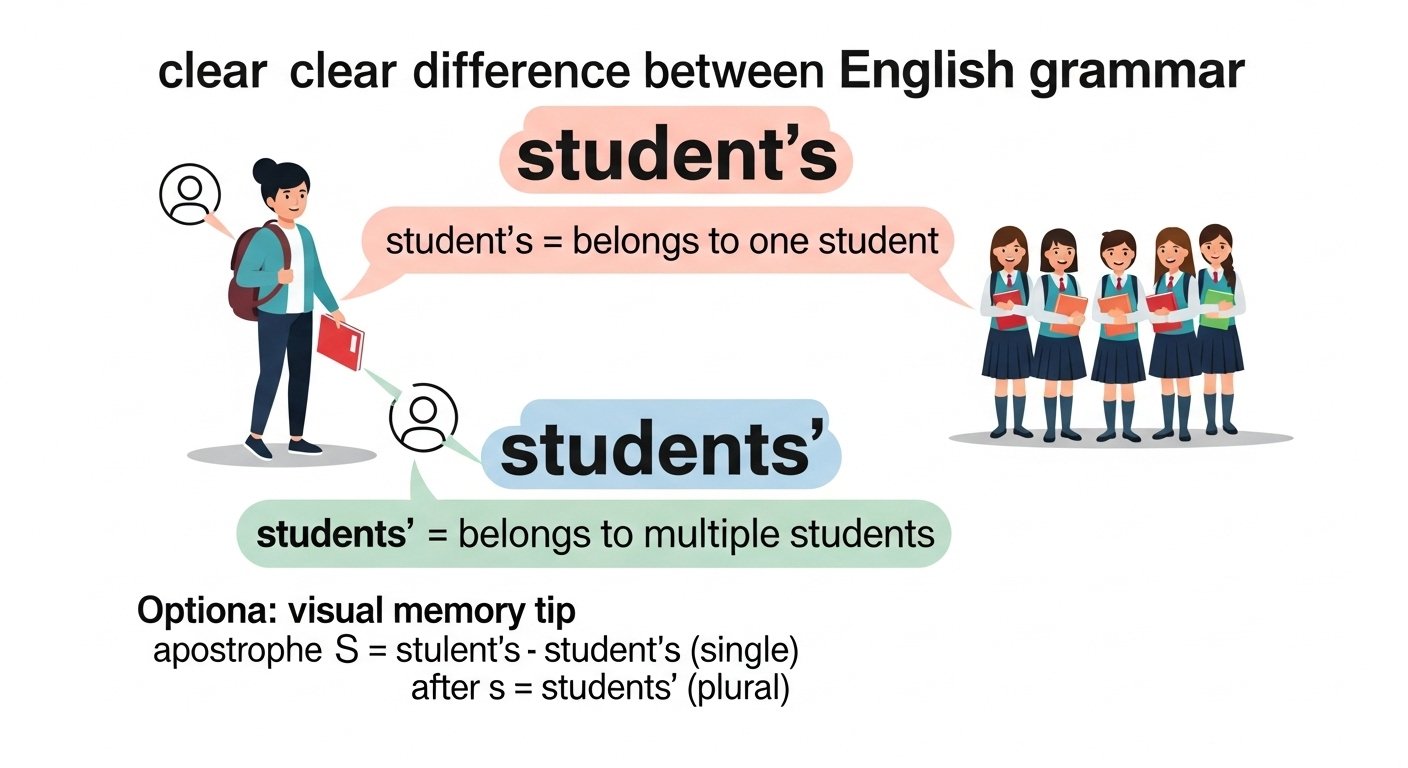
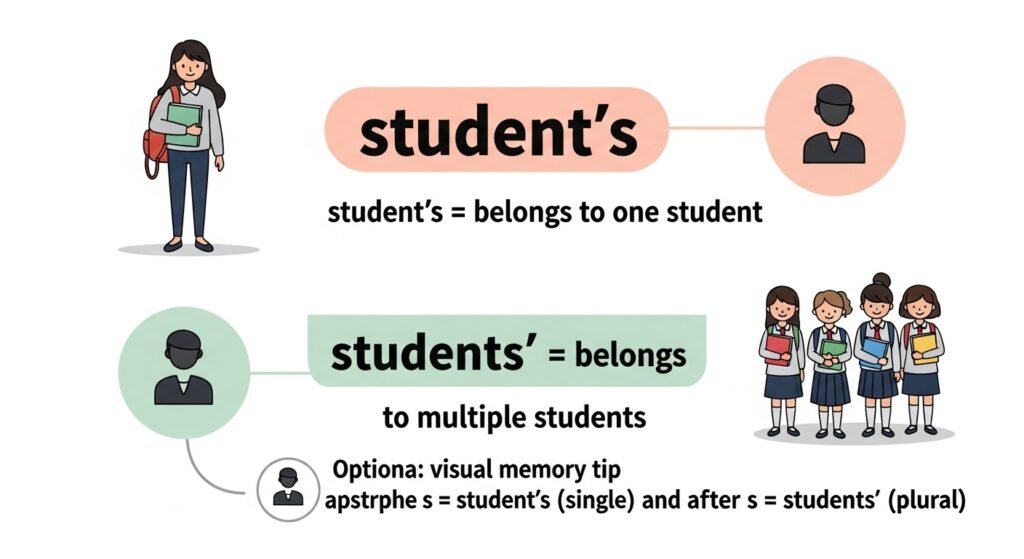
Understanding the difference between students’ and student’s is essential for clear and correct English writing. These two forms often confuse learners because both indicate possession but differ in number. In short, student’s refers to something belonging to a single student, while students’ refers to something belonging to multiple students. Mastering these forms ensures your sentences are precise, professional, and grammatically correct.
Definition Of Students’ And Student’s
Basic Definition Of “Students’ And Student’s”
Student’s
- Part of Speech: Possessive noun (singular)
- Pronunciation: /ˈstjuː.dənts/ (British), /ˈstuː.dənts/ (American)
- Definition: Indicates that something belongs to one student.
- Example: The student’s backpack was left in the classroom.
Students’
- Part of Speech: Possessive noun (plural)
- Pronunciation: /ˈstjuː.dənts/ (British), /ˈstuː.dənts/ (American)
- Definition: Indicates that something belongs to more than one student.
- Example: The students’ grades were posted online.
In short, student’s = singular possessive, students’ = plural possessive.
Historical Evolution (If Relevant)
The possessive apostrophe in English evolved from Middle English, where adding an -s or -es signaled possession. Over time, the apostrophe became standard to clarify ownership, especially in singular vs plural forms. By the 18th century, grammarians formalized the rules we follow today: student’s for singular possession, students’ for plural.
Any Different Meanings In Different Contexts
While student’s and students’ primarily indicate possession, context can slightly shift meaning:
- Student’s responsibility – implies individual accountability.
- Students’ responsibility – implies collective accountability of a class or group.
In academic and formal writing, confusing these forms may alter the sentence’s meaning, making singular actions appear collective, or vice versa.
How To Properly Use Students’ And Student’s In A Sentence
Grammatical Rules
- Student’s
- Always used for singular nouns.
- Apostrophe before the “s” signals singular possession.
- Example: The student’s essay was outstanding.
- Students’
- Always used for plural nouns ending in -s.
- Apostrophe after the “s” signals plural possession.
- Example: The students’ essays were graded yesterday.
Rule of Thumb: If you are talking about one student, use student’s. If talking about multiple students, use students’.
Parts Of Speech
Both student’s and students’ function as possessive nouns. They modify another noun by showing ownership. For example:
- Student’s notebook – the notebook belongs to one student.
- Students’ notebooks – the notebooks belong to several students.
They are not adjectives, though they behave like adjectives in sentences because they describe a noun.
Examples Of Using Students’ And Student’s In A Sentence
1. Possessive Form: Students’
- The students’ uniforms were neatly folded in the locker room.
- All the students’ projects were displayed in the exhibition.
- The students’ opinions were taken into consideration during the meeting.
- The students’ library cards were checked at the entrance.
- The students’ feedback helped improve the course.
2. Possessive Form: Student’s
- The student’s backpack was misplaced in the hallway.
- The student’s performance impressed the teacher.
- The student’s question sparked a long discussion.
- The student’s desk was positioned near the window.
- The student’s essay received the highest grade in class.
Edge Cases Or Things To Consider
Common Mistakes People Make When Using Students’ And Student’s
- Confusing singular and plural possession: writing student’s books when referring to multiple students.
- Misplacing the apostrophe: writing students’s instead of students’.
- Omitting the apostrophe entirely: writing students books.
These errors can change meaning or appear unprofessional in writing.
Cultural Or Regional Differences
American and British English generally follow the same rules for possessives. However, some style guides differ:
- AP Style (U.S.) prefers students’ rights without overusing apostrophes in plural possessives.
- British English occasionally allows dropping the apostrophe in informal writing, but formal academic writing always includes it.
Remember, for academic writing, always follow standard possessive rules.
Synonyms Or Alternates To Use
If you want variety or precision, consider these alternatives for student’s/students’:
1. Pupils
- Example: The pupils’ essays were submitted early.
2. Learners
- Example: Each learner’s progress was documented.
3. Scholars
- Example: The scholars’ achievements were celebrated at the ceremony.
4. Apprentices
- Example: The apprentice’s tools were checked daily.
Using synonyms can help avoid repetitive use of student’s/students’, especially in long texts or academic papers.
Related Phrases Or Idioms
1. Student’s Pet
- Refers to a favorite student who receives special attention.
- Example: She was known as the teacher’s student’s pet for always volunteering first.
2. Students’ Union
- Organization representing students’ interests collectively.
- Example: The students’ union organized the annual cultural festival.
3. Student’s Dilemma
- Refers to personal academic or life challenges.
- Example: Choosing between two courses was a student’s dilemma.
4. Students’ Exchange
- Program where students study abroad.
- Example: The students’ exchange program included schools from five countries.
5. Student’s Progress
- Measurement of individual improvement over time.
- Example: The student’s progress was reviewed monthly by the teacher.
6. Students’ Lounge
- A common area for multiple students.
- Example: The students’ lounge was decorated with posters and beanbags.
Memory Tricks Or Tips To Remember The Difference
- Singular vs Plural Test: Ask yourself, “Does it belong to one student or many?”
- One → student’s
- Many → students’
- Apostrophe Position Trick:
- Before s = singular (student’s)
- After s = plural (students’)
- Example Visualization: Picture one backpack vs multiple backpacks. The apostrophe’s placement changes depending on the number of owners.
Comparison Table
| Feature | Student’s | Students’ |
|---|---|---|
| Meaning | Belonging to one student | Belonging to multiple students |
| Part of Speech | Singular possessive noun | Plural possessive noun |
| Correct Usage | One owner, apostrophe before s | Multiple owners, apostrophe after s |
| Common Mistakes | Using for multiple students | Writing students’s |
| Example Sentence | The student’s notebook is neat | The students’ notebooks are neat |
FAQs
Q1: Can I use student’s for more than one student?
No. Use students’ for plural possession to avoid grammatical errors.
Q2: Why do we use an apostrophe in student’s and students’?
The apostrophe indicates possession, showing who owns or is associated with something.
Q3: Is there a difference between American and British usage?
Minor stylistic differences exist, but academic writing always uses the apostrophe correctly in both versions.
Q4: Can I replace students’ with other words?
Yes, words like pupils, learners, scholars, or apprentices can replace it for variety.
Q5: How do I know where to place the apostrophe?
Singular → before s; plural → after s. Think of ownership and number of owners.
Q6: Are there common idioms using student’s or students’?
Yes, phrases like student’s pet, students’ union, and student’s dilemma are widely used.
Conclusion
Mastering students’ and students’ is a small but crucial step in writing accurately in English. By understanding singular vs plural possession, placing the apostrophe correctly, and using examples or synonyms, you can write clearly, avoid confusion, and enhance your academic or professional writing. With memory tricks and practice, these possessive forms become second nature, making your communication precise and authoritative.